Give way and stop are not the same instruction.
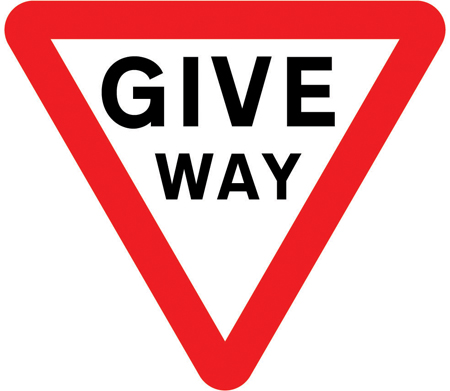
Give way
At a junction with broken white lines across your lane, you must give way to main-road traffic. Slow enough to make a safe decision. You may need to stop; you do not continue just because the road looks quiet from a distance.
Highway Code rule 172
Stop
With a stop sign and solid line, you must stop behind the line, even when the road appears empty. After stopping, look again and wait until it is safe to join.
Highway Code rule 171The sign and marking are instructions, not reference points for steering. Your position must still give you a useful view without putting the front of the car into traffic.
Look for people, not just a gap between cars.
Check both directions on the main road and the space you intend to enter. Include pavements, cycle lanes and places a motorcycle could be hidden. A windscreen pillar or parked vehicle can briefly hide someone; move your head to check the view, without moving the car into danger.
When turning into or out of a road, give way to pedestrians crossing or waiting to cross it. Do not turn across a cyclist continuing ahead. The junction rules explain these priorities and why an indicator alone is not proof that an approaching vehicle will turn.
If the view is restricted
Reduce speed earlier. Stop if you cannot decide safely. If you need to improve your view, move forward only as far as is safe, at a speed that lets you stop immediately. If there is a stop line, complete the required stop first. Do not edge into the path of traffic simply to get a better view.
A safe gap is not a fixed number of seconds.
Consider the speed of approaching traffic, the view, the distance you must cross and how quickly your own car can join smoothly. Turning right crosses more traffic than turning left. Wet roads, a slope or slow-moving traffic can change the decision.
You need enough space to complete the movement without making someone brake or swerve for you. If you are unsure, wait and assess the next gap. Pressure from a vehicle behind does not make a gap safer.
A driver is signalling left. Can you go?
You are waiting to emerge. A car approaches from your right with its left indicator flashing.
Think about it, then reveal the answer
Do not pull out on the signal alone. Watch the car’s actual movement and check for other road users, including anything hidden behind it. Only emerge when the whole situation is safe. The signal could have been left on, or the driver could be turning somewhere else.
Before a yellow box, check the exit.
When going straight ahead or turning left, do not enter a yellow box unless your exit road or lane is clear. A green traffic light does not create space on the other side.
There is a specific exception when turning right: you may enter and wait if only oncoming traffic, or other right-turning vehicles, prevent you completing the turn. It does not allow you to enter when your exit is blocked by a queue. At a signal-controlled roundabout, you must be able to cross its box completely without stopping. See rule 174.
Practise one decision at a time.
Layna’s junctions lesson separates each road situation. Pause the scene, change the camera and answer the questions about observations and decisions.
- Turning left at a Give Way junction
- Stopping at a Stop junction
- Waiting before a box junction
- Turn right across an oncoming lane
- Cross a main road from a side road
Use these demonstrations away from the road. Build the real observation, control and gap judgement with your driving instructor. Next, compare these decisions with roundabout lane choice and giving way or pedestrian-crossing priorities.