Junctions
Approach, observe and negotiate different junctions without cutting corners or forcing a response.
Turning left at a Give Way junction
Read the sign and line, look along the main road and choose a safe gap.
36 seconds · then three questions
1 of 4
Read the junction early
You are turning left. Check mirrors, signal in good time and reduce speed as the Give Way sign comes into view.
Look for: The upside-down triangle and the broken lines ahead.
Try the decision in this scene
The blue car is approaching from your right. What should you do here?
Signs and markings in this scene
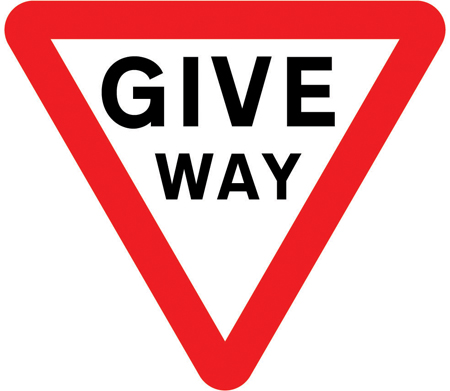
Give priority to traffic on the major road.

Give way at the broken double white line and do not enter unless it is safe.
Two broken lines across your lane
Give priority to traffic on the main road. The triangle points back towards approaching drivers.
Read all steps
Read the junction early
You are turning left. Check mirrors, signal in good time and reduce speed as the Give Way sign comes into view.
Wait for the approaching car
The blue car is travelling along the main road. Stay behind the line while it passes. Look in both directions, including the pavements.
Recheck, then turn
The car has passed. Check again before moving into the near lane. A useful signal tells others your intention; it does not give you priority.
Settle into the new road
Straighten the steering, check your mirrors and cancel the signal. Continue at a speed suited to the new road.
About this demonstration
The scene demonstrates a decision, not a fixed steering point or an exact pedal pressure. The manual example stays in first gear for this slow approach; it is not a gear-changing lesson. Layout and timing are simplified for teaching. Learn the controls and observations for your own car with your instructor.
Contains public sector information licensed under the Open Government Licence v3.0. © Crown copyright. Licence.
Read the full lesson and worked examples
Learn the skill
Combine a controlled approach with effective observation before committing to a path across other people’s routes.
Read the junction before reaching it
Find the signs, stop or give-way lines, lanes and intended exit. Check mirrors, give a useful signal and set position and speed early. Look for pedestrians waiting to cross the road you are turning into or out of, as well as vehicles on the main road.
Match the approach to the view
An open junction lets you gather information early. A hedge, parked van or building may hide traffic at a closed junction. Slow sufficiently and stop if needed. At a Stop sign, make a complete stop at the line even if the road appears clear.
Find a safe gap, not just an empty patch
Observe both ways and continue checking as you decide. Consider the speed and distance of approaching traffic, cyclists and motorcycles, and whether your exit is clear. No one has automatic priority at an unmarked crossroads. Do not rely on a flash or an indicator alone.
Complete the turn without creating a new conflict
Give way to pedestrians crossing or waiting to cross the road you are turning into or out of. Do not cut across a cyclist continuing ahead. Keep a controlled path without cutting the corner, enter the correct lane and check mirrors once established.
Keep this in mindLook, understand the gap, then move. Do not make the decision before completing the observation.
Recognise it on the road
Give way
Give priority to traffic on the major road.

Stop
Stop at the line and give way before proceeding.
Put it into practice
Think through each situation, then open the explanation.
Situation 1You stop at a give-way line, but a parked van blocks your view.
What to do
Only edge forward under control where it is safe to improve the view; stop again if the space is not safe.
Why
You need a view without projecting blindly into traffic or blocking a pedestrian’s path. “Creep and peep” is not permission to emerge.
Situation 2A driver leaves a gap in a queue for your right turn.
What to do
Check for cyclists and motorcycles filtering past the queue before crossing it.
Why
The gap in one lane does not prove the whole route is clear.
Practising in a car and preparing for the test
Practising in a car
Build from quiet open junctions to closed, unmarked and multi-lane junctions. Repeat left, right and emerging decisions.
What good driving looks like
- My approach speed leaves time to see and stop
- I recheck the nearest threat before moving
- My position and turning path protect other road users
Common mistakes
- Arriving too fast to observe
- Looking once and moving after the gap changes
- Cutting a right-turn corner
In the driving test
Junction observation is consistently among the most common practical-test fault areas.