The same exit can need a different approach lane
These two simplified approaches both have an exit ahead. The painted arrows assign it differently. Read the signs and markings on your approach before choosing a lane.
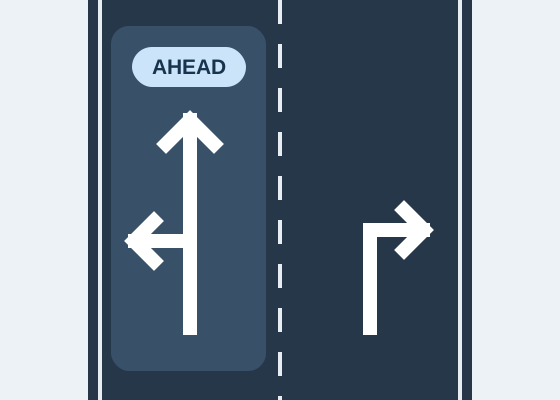
Example A: ahead from the left lane
The left lane’s arrow includes ahead. In this example, choose that lane early if you are going ahead.
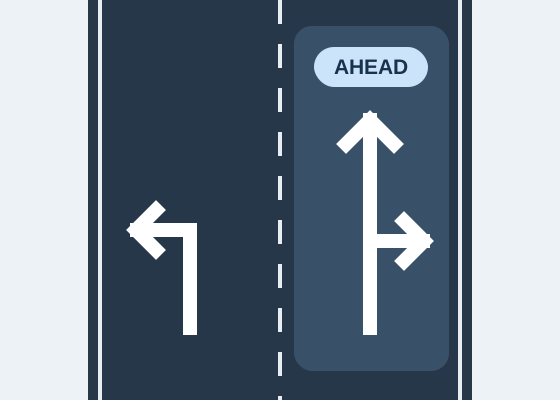
Example B: ahead from the right lane
Here, the left lane is left-only. The right lane includes ahead. Follow the lane markings through the junction too.
Roundabouts, step by step
Choose the correct lane early, judge your own entry and leave without crossing somebody else’s path.
Use signs and markings to choose the lane
Identify the exit and lane before arrival. Normally use the left lane for a first exit and the right lane for an exit to the right or a full circle, unless signs or markings say otherwise. Intermediate exits depend on the layout; avoid treating a clock-face shortcut as a rule for every roundabout.
Approach ready to wait or proceed
Check mirrors, signal appropriately and reduce speed enough to assess traffic. Give priority to traffic from the right unless signs, markings or traffic lights direct otherwise. Look ahead too: the car in front may stop even when you see a gap.
Keep the chosen path predictable
Maintain the correct lane and a suitable speed. Large vehicles may need more than one lane. Cyclists and horse riders may stay in the left lane while continuing around; do not cut across them because they are not following your car’s lane convention.
Check and signal before the exit
Normally signal left after passing the exit before yours. Check the mirrors and the space you will move into before leaving. Follow spiral markings where present. If the exit cannot be taken safely, continue on a safe permitted route rather than sweep across lanes.
Signs and lane markings come before memorised lane shortcuts.
Signs and markings to recognise
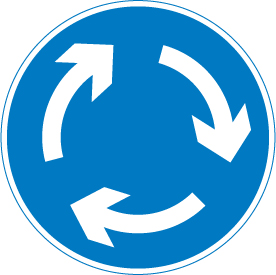
Mini-roundabout
Give way to traffic from the right and pass around the centre marking.
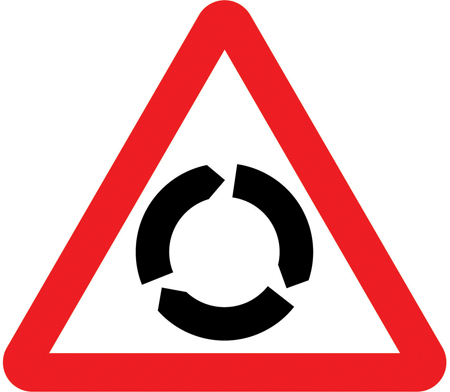
Roundabout ahead
A roundabout is ahead. Prepare to give way and choose your lane.
What would you do in these situations?
Read the situation, decide on an action, then compare it with the explanation.
The car ahead begins entering the roundabout.
What to do
Make your own gap judgement and keep watching the car ahead.
Why it matters
Its gap may close before you arrive, and it may still stop. Following it is not an observation routine.
A mini-roundabout’s painted centre lies in your path when travelling ahead.
What to do
Drive around it, keeping it on your right.
Why it matters
A normal-sized car must pass around the central marking. It is not decoration to drive straight over.
Which lane and signal should I use?
Read any advance lane signs as well as the road surface. The examples above illustrate why counting exits—or applying a “12 o’clock rule” on its own—can give the wrong answer. Where there is no specific direction from signs or markings, use the normal approach guidance below.
- First exit to the left: normally approach in the left lane and signal left.
- An intermediate exit: choose the appropriate lane; an approach signal is not normally needed. Signal left after passing the exit before yours.
- An exit to the right or a full circuit: normally approach in the right lane and signal right, then signal left after passing the exit before yours.
- On a marked multi-lane roundabout, follow the lane guidance through the junction. Do not drift across lines while concentrating only on your exit.
Changing lanes—or finding yourself in the wrong one
Before a necessary lane change, check the relevant mirrors and any blind area, signal when it helps, and establish that the space is clear. A signal asks others to understand your plan; it does not make them give you a gap.
If it is too late to reach your intended exit safely, follow the permitted route from your lane. Take another exit and find a safe way back. Going round again is not always possible: some lanes lead directly off the roundabout. Never stop suddenly, reverse or cut across traffic to rescue the route.
Who goes first, and what changes at a mini-roundabout?
Normally give priority to traffic approaching from the right, unless signs, markings or lights direct otherwise. Still check ahead and watch people already on the roundabout. Do not assume a vehicle will leave just because its indicator is on.
A mini-roundabout uses the same approach principles in a much smaller space. Pass around its painted central marking; the exception is for large vehicles physically unable to do so. Avoid U-turns. At a double mini-roundabout, make a separate decision at each one.
More questions learners ask
Can a cyclist stay in the left lane to go around?
Yes. Cyclists and horse riders may keep left while continuing across or around the roundabout. Give them space and do not cut across their path to exit. A position near the left edge does not mean they must be leaving at the next exit.
Do I fail the driving test for taking the wrong exit?
A wrong direction alone is not a driving fault. The way you respond matters. Continue safely and follow the examiner’s next instruction instead of making a late, unsafe change to get back on route.
Does the second exit always mean the left lane?
No. The lane depends on the signs, road markings and layout. “Second exit” alone does not tell you which lane to use. Read the approach, choose early and avoid a sudden lane change to rescue a missed exit.
Watch the decisions in 3D
Choose the situation you want to understand. In the learning area, you can replay the steps, change the view and answer the lesson questions. The demonstrations are slowed teaching sequences, not real-time speed or pedal-pressure guides.
Use this before or after a driving lesson
Work through the explanation away from the road. In the car, practise with your instructor or a suitable supervising driver. Reading a guide or completing a quiz records understanding, not a practical driving assessment.
Your quizzes and study progress stay in the learning area. For the wider sequence, return to the practical driving curriculum.