Keep the car held until the start is ready
Facing uphill, gravity pulls the car back down the slope. A selected gear is not a guarantee against rolling. Keep a reliable brake hold while you prepare and observe.
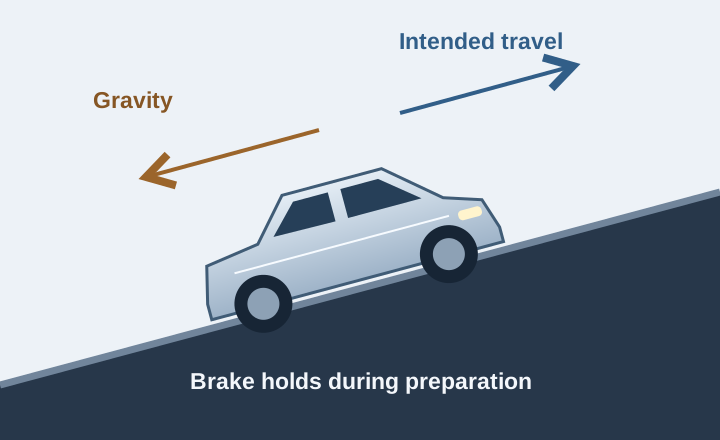
Holding and moving are separate jobs
Before releasing the holding brake, prepare the appropriate controls and make fresh observations. If the car rolls the wrong way, stop and secure it before resetting.
Hill starts, step by step
Practise holding, preparing and moving as separate stages before trying to make the routine quicker.
Hold the car before preparing
Use the appropriate brake to keep the car stationary. Leave space from other vehicles. Identify whether you are moving uphill or downhill and how the slope will affect the direction you intend to travel.
Prepare the controls for the slope
For a manual uphill start, practise coordinating a suitable gear, clutch and accelerator with your instructor. In an automatic, learn the selector, brake and assistance systems in that car. Do not assume that selecting D prevents it rolling backwards.
Check the space again
Look along the road and check the relevant blind spots before moving. If you have waited while preparing the controls, refresh the observations. An approaching cyclist or a passing vehicle may have changed the decision.
Move progressively, or reset safely
Release the holding brake when the car is ready to move under control and the road is safe. If the car begins moving the wrong way, bring it back under control and secure it; do not rush to save the attempt. Reset with your instructor.
A safe reset is better than completing a start that is no longer controlled.
What would you do in these situations?
Read the situation, decide on an action, then compare it with the explanation.
A car stops very close behind you on a slope.
What to do
Keep your car secure. Take the time needed to prepare and check rather than letting the other driver hurry you.
Why it matters
Less space makes an uncontrolled movement more consequential. It does not make a hurried release of the brake safer.
The car you are borrowing has an electronic parking brake.
What to do
Learn its release and holding behaviour while safely stationary before attempting the hill.
Why it matters
The release process may differ from the manual lever you practised with. A familiar badge or gearbox type does not guarantee identical controls.
Manual and automatic: what changes?
Manual car
Coordinate clutch and accelerator before releasing the holding brake as taught for that car. Do not hold position for a long wait using clutch slip.
Automatic car
Keep the car held while selecting the correct direction. Creep, hill-start assist and auto-hold vary; use the handbook and supervised practice to understand when movement begins.
The observations and decision to move safely apply to both. Learn the controls for your particular car with your instructor.
What changes when facing downhill?
The slope may help the car move, so copying an uphill accelerator input can give you more movement than you intended. Keep it held, select the appropriate gear or direction and control the release and speed for that car. Avoid rolling in neutral or coasting with the clutch down.
Ask to compare a gentle uphill and downhill start during supervised practice. Before each attempt, say which way gravity will pull the car and which control is currently preventing movement. That check makes the difference easier to understand than memorising two unrelated routines.
How to do a hill start in a manual car
A parking-brake start gives you a way to keep the car still while preparing the clutch and accelerator. Practise on a suitable slope with your instructor. An electronic brake may release differently from a hand-operated lever; check the procedure for that vehicle.
- Hold the car securely and select the appropriate moving-off gear.
- Prepare the accelerator and clutch together as taught for that car and gradient.
- Check the road, mirrors and relevant blind spots; signal if it will help someone.
- When ready and safe, release the holding brake and move progressively. Continue releasing the clutch as appropriate; do not stay balanced on it.
How to do a hill start in an automatic car
Use the footbrake while selecting the required direction, and keep the car secure until you can move. Automatic does not mean rollback-proof. Some cars creep strongly, some weakly, and some do not creep at all.
- Understand the parking brake and any hold system before starting.
- Select the direction with the car held, then make effective observations.
- Use the vehicle’s taught brake-release and accelerator sequence to move smoothly. Do not rely on D alone to hold position.
- If movement is not controlled, stop and secure the car; reset instead of adding a burst of acceleration.
Hill-start assist is not the same as auto-hold
Hill-start assist commonly keeps brake pressure briefly after you release the footbrake, giving you time to move to the accelerator. Activation conditions and release behaviour vary. Auto-hold may keep a stationary vehicle held until a particular release action, but the name alone does not tell you exactly how your car works.
Read the handbook and practise the release with your instructor. Do not rely on an assumed number of seconds or assume the system activates on every slope. If a warning says the assistance is unavailable, keep control with the brakes and follow the handbook’s advice; do not experiment in traffic.
More questions learners ask
What should I do if the car starts rolling backwards?
Stop the unintended movement with the brake and secure the car. Then reset the controls and observations with your instructor. Do not try to rescue the start with a sudden accelerator input, and do not let a close-following driver hurry you.
Does rolling back automatically fail a driving test?
There is no universal distance that guarantees a pass or fail. The examiner assesses the loss of control and its actual or potential effect. Practise preventing rollback and recovering safely rather than trying to learn an “allowed” amount.
Will hill-start assist always stop rollback?
Do not rely on that assumption. Hill-start assist and auto-hold are different systems, and their operating conditions vary. Learn when your car holds, when it releases and what you must do if it does not activate. A dashboard feature does not replace keeping the car secure.
Watch the decisions in 3D
Choose the situation you want to understand. In the learning area, you can replay the steps, change the view and answer the lesson questions. The demonstrations are slowed teaching sequences, not real-time speed or pedal-pressure guides.
Use this before or after a driving lesson
Work through the explanation away from the road. In the car, practise with your instructor or a suitable supervising driver. Reading a guide or completing a quiz records understanding, not a practical driving assessment.
Your quizzes and study progress stay in the learning area. For the wider sequence, return to the practical driving curriculum.