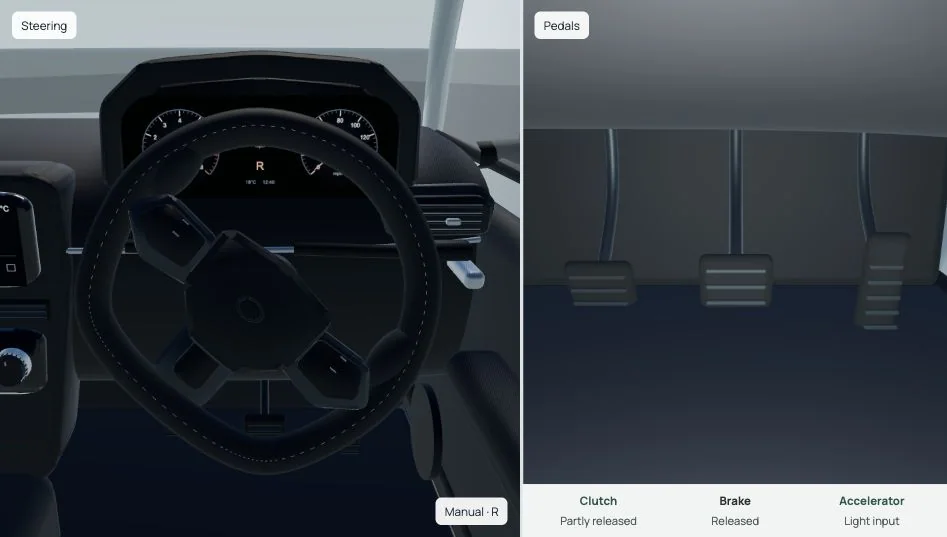
Car controls: steering, pedals and gears, step by step
Understand what each control changes, so operating the car does not take your attention away from the road.
Separate direction from speed
The steering wheel changes direction; the accelerator and brake manage speed. Make smooth inputs and look towards the road you intend to follow. A tight steering angle needs an appropriately low speed, not a last-second struggle with the wheel.
Learn the transmission in this car
A manual needs the correct gear for the speed and load, with coordinated clutch use. An automatic changes gears for you but still needs correct selector use and speed control. Check the handbook: creep, hill hold and regenerative braking vary between cars.
Learn secondary controls while parked
Find the indicators, lights, wipers, washers and demisters before setting off. Practise locating them without searching down at the dashboard. If a control task is taking your attention away from driving, stop safely before dealing with it.
Read the car’s response
Know the speedometer, fuel or charge display and warning symbols. If a warning appears, identify its meaning and follow the handbook. Do not keep driving a car that may be unsafe simply because the engine still runs or a warning can be dismissed.
Learn the controls while stationary; use them without losing the road picture when moving.
What would you do in these situations?
Read the situation, decide on an action, then compare it with the explanation.
An automatic begins moving when you ease off the brake in D.
What to do
Use the brake to keep a controlled speed and learn the car’s creep behaviour with your instructor.
Why it matters
Selecting a drive position can allow movement without accelerator input. Automatic does not mean the car manages the situation for you.
You are descending a long hill in a manual.
What to do
Use a suitable gear and controlled braking; do not coast in neutral or with the clutch held down.
Why it matters
Coasting removes engine braking and can allow speed to build, reducing control.
Manual and automatic: what changes?
Manual car
Use the left foot for the clutch and the right for brake and accelerator. Change gear for the road and engine load, not a universal speed chart. Avoid resting a foot on the clutch.
Automatic car
With the usual unadapted pedals, use the right foot for brake and accelerator. Hold the car securely with the brake when selecting a drive position. Stop fully before changing between forward and reverse.
The observations and decision to move safely apply to both. Learn the controls for your particular car with your instructor.
What should you practise first?
Start by finding each control while the car is securely parked. Can you move your foot to the brake without looking down? Can you reach the indicator and wipers from your normal seating position? Adjusting the seat is part of the task, not something to work around.
Then separate the skills. Watch the steering demonstration to follow a bend and straighten. Use the manual gear lesson to see clutch and accelerator coordination, or the automatic lesson to follow the selector and brake. Repeat the view that answers your question rather than trying to memorise every movement at once.
Which foot should I use for the pedals?
In a usual unadapted manual car, use your left foot for the clutch and your right foot for the brake and accelerator. In a usual automatic, use your right foot for the brake and accelerator. Adapted controls can differ; learn the arrangement in the car you will drive.
Watch the decisions in 3D
Choose the situation you want to understand. In the learning area, you can replay the steps, change the view and answer the lesson questions. The demonstrations are slowed teaching sequences, not real-time speed or pedal-pressure guides.
Move off uphill without rolling back
Keep the car held on the slope until it is ready to move. Compare manual and automatic controls.
Open this demonstrationSteer through a bend and straighten
Watch the steering wheel and front wheels change together as the car follows a left-hand bend.
Open this demonstrationCoordinate clutch, accelerator and gears
See first, second and third selected in sequence, with a clutch-down pause during each change.
Open this demonstrationUse D, the brake and P in an automatic
Select drive while held, control the slow movement with the brake, then stop before selecting park.
Open this demonstrationUse this before or after a driving lesson
Work through the explanation away from the road. In the car, practise with your instructor or a suitable supervising driver. Reading a guide or completing a quiz records understanding, not a practical driving assessment.
Your quizzes and study progress stay in the learning area. For the wider sequence, return to the practical driving curriculum.
Work on the part that feels difficult
Changing gears without losing track of the road
Separate gear position, gear choice and pedal coordination.
What happens if you stall on a test?
Understand the assessment and practise a calm recovery.